Prepared September 15, 2026. Independent planning scenario, using the best currently acquired records and explicit assumptions. Independent research, published on the Atlas research pages on October 13, 2026; no City approval, appropriation, or construction authorization. Amounts are working allowances rather than engineering estimates. Dates are proposed targets, not City schedules.
Recommendation: establish an approximately $850 million ten-year program to resolve the recorded stock of needs, protect a separate $60 million annual provision for subsequent renewal, and make the major facility decisions before releasing their construction money. The resulting gross ten-year investment requirement is approximately $1.45 billion in modeled 2026 dollars, before deducting verified existing funding. Ordinary bureau operating services and financing interest are outside that total. Some program, inspection, and maintenance costs may require operating appropriations rather than bond proceeds.
This is a concrete proposed allocation and sequence. It is optimized against a stated priority proxy and capacity assumptions. It is not proof of a global public-benefit optimum, an adopted City plan, or that every historical scope should be built.
What the new evidence changes
The downloadable PP&R backlog map workbook, published September 14 and downloaded September 15, contains 2,585 distinct CIP IDs: 1,812 Open and 773 Close. Publication date is not verification that every underlying record is current. The extract includes priorities, equity scores and growth classifications, but no cost field.
The plan covers all 1,195 historical KGW rows and assigns a disposition to all 2,585 current-extract IDs:
- 1,482 open IDs enter the existing-service/access program: 1,234 labeled 0% growth, 86 labeled 50%, and 162 accessibility entries labeled 100%. Growth labels are not used to exclude apparent existing-access obligations automatically. Their precise legal and service scopes still need review.
- 330 other open growth entries receive an alternatives review by December 2027, rather than automatic construction funding within a repair program. They can be candidates for a more beneficial alternative to a historical proposal.
- 773 Close IDs require status interpretation, not an assumption that construction is complete. Some share a scope group with an open record.
- 37 historical rows, totaling $7.0 million in the old table, lack a current candidate link. Their allowances remain in the plan; absence from the newer table is not treated as proof of completion.
Candidate links use property identity and normalized project titles, with descriptions to disambiguate. Three contextual links connect renamed/broadened Southwest Community Center and Lair Hill projects. Ambiguous records are grouped at scope level. Matching is not independent verification of asset identity or completion.
143 historical rows totaling $60.86 million sit in groups whose candidate current records are all Close. They leave the automatic new-award queue pending a first-quarter status check. This is neither a claimed saving nor a reduction in the City's published backlog. Examples include the $10.73M CJCC roofing line and the $5.10M MAC HVAC placeholder. Reopen any still-required need and use the program reserve/reprioritization process. The two identical Indian Creek historical rows correspond to two distinct open CIP IDs (1232 and 1233); neither is deleted merely because the text and price repeat.
The City's separate current headline is $759 million as of August 2026. It does not have the same scope, date, price basis, or inclusion rules as the KGW table or this plan. Do not subtract one total from another to claim growth, savings, or reconciliation. PP&R Sustainable Future.
The budget I would work toward
| Step | Working amount |
|---|---|
| Original 1,195-row historical estimate sum | $615.704M |
| Historical amounts associated with all-Close candidate groups, held out of automatic new awards | −$60.860M |
| Historical amount retained for open or unresolved needs | $554.844M |
| Retained amount multiplied by 1.04³ as a provisional 2023-to-2026 price bridge | $624.124M |
| Allowances for newer/unpriced needs using historical analogues | $56.0M |
| Base project/scope allowances | $680.1M |
| 25% controlled program and uncertainty reserve | $170.0M |
| Recorded-stock program | $850.2M |
| Separate provision for subsequent needs: $60M × 10 years | $600.0M |
| Ten-year gross investment requirement | $1,450.2M |
The source calls its column Escalated Estimate and does not supply individual estimate dates or price bases. The 4% annual bridge is therefore an explicit planning assumption, not a verified reindexing. It must be replaced by current scoped prices. The 25% reserve is a policy allowance, not an asserted statistical confidence level or proof that the original estimates omit contingency. Do not add it automatically to individual contracts.
Approximately 8.2% of the base program is imputed. Exact-title medians are used where at least three historical examples exist. Some parking scopes use explicitly stated area and the historical condition-specific full-estimate/area patterns. Otherwise, the fallback is a work-family median. The 161 standardized ADA pathway entries use the median historical whole-property Pathway Renovation allowance. These are budgeting placeholders, not unit-price or design estimates. Different quantities, current scope changes, and parent/component overlap may materially change them.
Use the $170M reserve for documented estimate revisions, necessary scope, delivery support, temporary service protection and unexpected valid reactivations. An initial $4M draw should fund mobilization, engineering checks and cost/status reconciliation. It is included in the reserve, not additional to $850M. The annual table places that cash in FY 2027–28; authorizing the draw in FY 2026–27 would shift $4M earlier and reduce the first scheduled year by $4M.
Ring-fence up to $6M per year of the reserve for incremental program delivery where project estimates do not already pay for it. A planning staffing mix is 24 FTE-equivalents at an assumed $200,000 fully loaded average plus $1.2M of procurement, estimating, independent review and systems support. This is a capacity proposal, not a salary study or a finding of 24 current vacancies. Credit existing funded staff and consultant allowances before adding cost. Do not count the same administration in project budgets and the central reserve.
Why a recurring $60M provision is necessary
The 2024 Citywide Assets Report reports a $2.5B Parks replacement value, an estimated $50M annual capital major-maintenance funding gap, and a 2–3% reinvestment reference for systems in good condition. It also acknowledges undervaluation of natural assets. These are different measures; the $50M gap is not a measured annual deterioration rate. Report, printed page 21 / PDF page 23.
I propose $60M per year in 2026 dollars as a provisional systemwide renewal provision, broadly within that order of magnitude. It is not a bureau forecast of new needs. Release it only for distinct post-snapshot renewal/condition needs and related sustaining work, with no duplicate charge for the 952 packages in this plan. Known recurring events already in the snapshot are funded there for their first included cycle; subsequent due cycles draw on renewal funding. Replace the flat provision with an asset-age, replacement-cycle and condition forecast as that becomes available.
Keep ordinary cleaning, routine maintenance, recreation staffing, utilities, tree care, and baseline program operations funded separately. Renewed assets still need those services. Any option increasing those obligations needs its own approved operating plan. No fees, grant awards, partner contributions, energy savings, or administrative savings are assumed to pay the gross requirement before verification.
At 4% annual future price growth, the ten-year investment cash total would be approximately $1.83B nominal, excluding financing interest and ordinary bureau operations. This is an assumption scenario, not a funding forecast. The proposed steady provision cannot be presented as enough to prevent every future failure; compare actual new needs with completions every year and adjust it.
The delivery sequence
Now through March 2027: inspect, reconcile, and make services safe. Establish one accountable program lead, finance/asset-management ownership, and workstream leads. Review all 60 open City records with published project scores of 75 or above, starting with documented hazards or service threats. Inspect uncertain structures as indicated by qualified staff. Apply safe interim controls immediately when findings warrant them. A score is not an engineering finding or a legal deadline.
Reconcile the 143 historical all-Close rows, the 37 unmatched rows, the major parent/component scopes, and every imputed allowance proposed for the first construction year. Confirm the largest 20 historical scopes first because of their influence on cost, alongside urgent inexpensive work. Secure the first $4M reserve draw. Do not wait for a systemwide data cleanup to fix a verified hazard.
By December 2027: decide the service options for every major case. Compare minimum safe renewal, repair/reconfiguration, shared or partner operation, and major redevelopment. Record ordinary operating costs, closure alternatives, annual renewal obligations, staffing, and distributional effects. Retain a cost allowance while the alternative is chosen; do not promise that the historical design will be constructed.
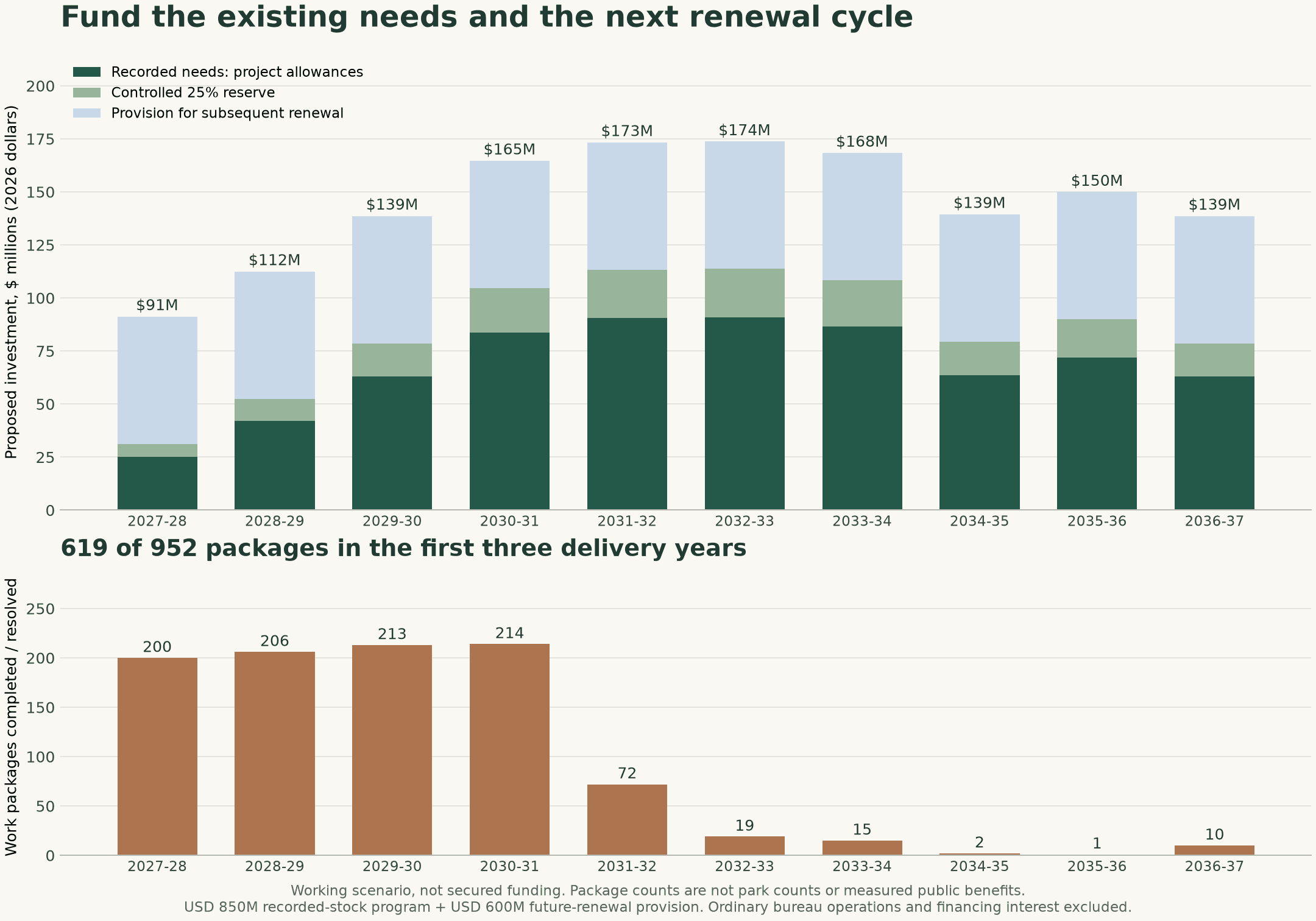
FY 2027–28 through FY 2029–30: complete 619 work packages and start necessary larger work. The model spends approximately $162.3M of recorded-stock funding during these three years, including reserve and work in progress. That cash does not represent the cost of the completed packages alone. Deliver safety/compliance items, usable routes, play surfaces, critical systems, efficient small renewals, and restoration work through coordinated programs. Package quantities are site/workstream units, not park counts or lives improved.
FY 2030–31 through FY 2033–34: complete the next 320 packages. Approximately $439.9M of recorded-stock cash falls in this phase. Deliver bridges, larger roofs and systems, verified field/surface work, and approved facility alternatives. Coordinate work to avoid repeatedly excavating the same site or replacing a component immediately before a whole-building project supersedes it.
FY 2034–35 through FY 2036–37: resolve the remaining 13 large packages. Approximately $247.9M of recorded-stock cash falls in this phase. Most are expensive facility or mixed-purpose decisions. Their alternatives are decided early, not left untouched until 2034. Inspect and fund necessary service continuity before the long-term intervention. A project may be repaired differently, combined, superseded, or withdrawn with a public service decision; those are different outcomes from construction completion.
The model completes all 57 packages carrying priority proxies of at least 75 by year four. Immediate safety action is handled earlier through professional triage; the model's completion year must never authorize an unsafe condition to remain.
| Fiscal year | Recorded-stock program, including reserve | Subsequent renewal provision | Gross annual investment, 2026 dollars | Packages resolved/completed |
|---|---|---|---|---|
| FY 2027-28 | $31.2M | $60.0M | $91.2M | 200 |
| FY 2028-29 | $52.5M | $60.0M | $112.5M | 206 |
| FY 2029-30 | $78.6M | $60.0M | $138.6M | 213 |
| FY 2030-31 | $104.7M | $60.0M | $164.7M | 214 |
| FY 2031-32 | $113.3M | $60.0M | $173.3M | 72 |
| FY 2032-33 | $113.7M | $60.0M | $173.7M | 19 |
| FY 2033-34 | $108.3M | $60.0M | $168.3M | 15 |
| FY 2034-35 | $79.4M | $60.0M | $139.4M | 2 |
| FY 2035-36 | $89.9M | $60.0M | $149.9M | 1 |
| FY 2036-37 | $78.6M | $60.0M | $138.6M | 10 |
All annual values are modeled constant 2026 dollars. The annual CSV also shows the assumed nominal cash values. Budgets are proposed capacity and funding targets; existing funding has not been comprehensively reconciled against them.
How I would divide the recorded-stock allowance
Every component appears in one dominant-work program. Mixed projects retain their full allowance in one program; these are not engineering component quantities or City accounting classifications.
| Work program | Scope components | Allowance including proportionate 25% reserve |
|---|---|---|
| Strategic facility and mixed-scope decisions | 13 | $286.4M |
| Fields and courts | 111 | $115.6M |
| Buildings and workspaces | 146 | $109.6M |
| Routes and accessibility | 364 | $94.4M |
| Parking and roads | 88 | $45.7M |
| Grounds and other assets | 140 | $39.1M |
| Roofs and envelopes | 87 | $37.8M |
| Building systems | 57 | $29.8M |
| Ecology | 59 | $28.9M |
| Playgrounds | 65 | $23.4M |
| Water and drainage | 55 | $18.0M |
| Energy and utility efficiency | 215 | $10.0M |
| Pools | 18 | $6.9M |
| Safety and compliance | 60 | $4.5M |
The allocation is calculated from scoped records and clearly labeled analogues; it is not an arbitrary percentage split of the budget. Reserve attribution in this table is for reconciliation. The reserve remains centrally controlled and is released on evidence.
Safety, routes, and basic recreation. These preserve access to multiple services and reduce exclusion. Coordinate accessible paths, entrances, drainage, play surfaces, restrooms, and safe swimming operations. Do not interpret every rough surface or condition-4 asset as an urgent hazard. Verify whether the work improves a route people can actually use. School access and modest program changes remain alternatives where they solve the same problem more effectively.
Buildings and workspaces. Protect roofs, critical utilities, fire protection and the staff infrastructure required to operate the system. Give essential enabling systems an explicit place in the program. Choose repair versus replacement using current quantities and expected life. Published condition is not a reason to replace every part of a building at once.
Ecology. Begin threat assessment, invasive-species control and habitat protection now, and stage restoration with funded establishment and monitoring. The restoration allowance includes mixed visitor-amenity descriptions in some historical cases; separate those scopes before procurement. Their inclusion does not entitle visitor amenities to the same urgency as irreversible ecological loss. Every ecology package has a resolution target no later than year six in the current schedule.
Energy and water. Bundle verified opportunities, establish a baseline and measure performance. Do not count projected savings as cash until they are realized. Check whether historical retrofit proposals have already been delivered or superseded.
Parking and grounds. Fund accessible circulation, emergency/maintenance access, drainage and genuine failures. Cosmetic work, added parking capacity and general site embellishment require a stronger service case. Validate quantities rather than using the old dollar sum as the procurement scope.
Strategic mixed scopes. Approximately $286M including reserve is held for major choices containing expansion or ambiguous scope. Keep that allowance contestable. New visitor centers, waterfront plazas or expanded facilities do not automatically outrank everyday access and existing-service reliability because they appear in the historical list.
Specific first-wave cases
These are proposed FY 2027–28 interventions, after immediate inspection/control where warranted. Figures include proportional reserve for comparison, not a contract authorization. The equal playground allowances reflect a missing-quantity fallback, not evidence that these jobs cost the same.
| CIP ID | Case | Working allowance | Cost evidence |
|---|---|---|---|
| 805 | University Park — Fire Protection improvement | $1.0M | Historical amount repriced |
| 4816 | University Park — Inspect and fix foundation | $0.1M | Category-median assumption |
| 4797 | Montavilla Park — Montavilla CC foundation renovation | $0.1M | Category-median assumption |
| 4724 | Ventura Park — Replace or fix play surface | $0.3M | Category-median assumption |
| 4871 | Thomas Cully Property — Replace Pour In Place play area surface | $0.3M | Category-median assumption |
| 4872 | Gateway Discovery Park — Replace Poured In Place play surface | $0.3M | Category-median assumption |
| 4873 | Lents Park — Replace Poured In Place play surface | $0.3M | Category-median assumption |
Other early work includes source-listed backflow needs, pole-base connections, roof leaks, and high-priority pathways, selected through the package ledger. Group procurement where specifications and site conditions support it, while maintaining separate scope and completion records. No bulk-purchasing savings are assumed.
The major facility decisions I would make
Montavilla: inspect and address the separate foundation issue now. Decide by December 2027 what services the center and pool must provide, whether staged renewal can maintain them, and what a rebuild adds. Keep the full legacy rebuild amount as a conservative allowance until that comparison is complete. Do not equate a low old whole-project score with permission to ignore a current foundation concern.
Charles Jordan: confirm the meaning of Close for roofing and other historic systems projects. Address the open fire-protection and foundation records. Compare expansion/therapy-pool concepts with preserving current service, operating changes, and alternative aquatic access. The current expansion description mentions $30M; this plan retains the dated cost-table basis as a labeled allowance rather than treating that narrative number as a scoped current estimate.
Southwest and Matt Dishman: scope essential continuity and component work before approving comprehensive renovations. Compare remaining component costs with whole-building alternatives, check what has already been delivered, and plan temporary access during closures. The model retains potentially overlapping amounts conservatively; the release budget must eliminate any overlap established by staff. Long-term dates assume interim work can preserve safe service. If engineering says it cannot, move the major option forward and show which lower-priority work is displaced.
Buckman tennis facility: validate current structure/power/operating risks and compare continued air-supported operation, resilient repairs, and a permanent structure. Do not authorize the historical $20M concept solely because the current database still marks the record Open. Evaluate partnership terms and public access separately from City cash savings.
Lair Hill and Overlook House: decide the required cultural/recreation function and any binding preservation obligations before full seismic/roof investment. Compare safe continued use, limited repair, adaptive use, another service location, or a managed transition where lawful. This is not a recommendation to demolish or close either facility. Their use, obligations and alternatives need to support the eventual scale of investment.
Washington Park and Waterfront: protect existing essential access, structures, utilities, staff facilities and public use. Defer approval of new visitor centers, canopy walks, plazas, decks and similar expansion scopes until a comparative access, utilization, lifecycle-cost and operating case is approved. Their late model dates are contingent allowances, not commitments to build those features. This uses public project descriptions and does not publish any private Waterfront proposal or correspondence.
Springwater and Albert Kelly bridges: confirm individual bridge IDs, engineering condition, route role, drainage and alternative crossings. The large Springwater descriptions are grouped because several IDs cannot be assigned to individual old prices. Albert Kelly's old amount includes a larger crossing, approach work and culvert removal; compare a scoped repair, replacement and reroute. Neither a photograph nor a whole-park condition share can decide the price or the priority.
The table below shows conservative allowance windows produced by the model. All major options decisions are due by December 2027. Early inspections and essential component work precede these windows where necessary. After an alternative is approved, replace its allowance and rerun the sequence.
| CIP ID | Major case | Allowance including reserve | Proposed long-term delivery window |
|---|---|---|---|
| 47 | Montavilla Park — Rebuild or Major Renovation | $65.3M | FY 2032-33 to FY 2034-35 |
| 57 | University Park — Expand facility; Develop strategy | $36.4M | FY 2033-34 to FY 2035-36 |
| 952 | Gabriel Park — Southwest community Center | $24.8M | FY 2034-35 to FY 2036-37 |
| 205 | Matt Dishman Community Center and Pool — Renovations and code upgrades | $19.4M | FY 2034-35 to FY 2036-37 |
| 2023 | Buckman Field — Replace tennis bubble with new structure | $28.1M | FY 2034-35 to FY 2036-37 |
| 911 | Washington Park — Visitor Centers | $31.6M | FY 2034-35 to FY 2036-37 |
| 912 | Washington Park — Playground and Recreation Improvements | $13.5M | FY 2031-32 to FY 2033-34 |
| 906 | Washington Park — Visitor Centers, Plaza Improvements, Food | $10.5M | FY 2035-36 to FY 2036-37 |
| 77 | Gov Tom McCall Waterfront Park — Hawthorne Bridge to Salmon Street Springs | $11.0M | FY 2032-33 to FY 2033-34 |
| 78 | Gov Tom McCall Waterfront Park — Salmon Street Springs to Morrison Bridge; Waterfro | $29.5M | FY 2034-35 to FY 2036-37 |
| 17 | Overlook House Community Center — Seismic / Structural | $13.1M | FY 2034-35 to FY 2036-37 |
| 12 | Lair Hill Park — Seismic/ Structural | $6.5M | FY 2030-31 to FY 2031-32 |
| 1739 | Lair Hill Park — Renovate the Roof of Special Facility building | $6.1M | FY 2031-32 to FY 2032-33 |
How the prioritization formula was actually applied
The full preceding method measures affected people, incremental service, duration, ecological outcomes and full lifecycle costs. The acquired records do not supply compatible person-level benefits, failure probabilities or annual operating costs. Inventing those quantities for every row would create false precision. This plan therefore applies an explicit reduced form:
Maximize Σ(package priority proxy × discounted years after package completion)

subject to:
  every included package receives a completion/resolution year;
  cash stays inside the proposed annual envelope;
  no more than 200 minor packages are delivered per year;
  no more than 50 $1M–$5M packages are active at once;
  no more than 10 $5M+ packages are active at once;
  scope-specific preparation times and service-priority deadlines are met.
The priority proxy uses the maximum published City project score within a site/work-program package, rather than adding every source row's score. This reduces the incentive to split one need into many rows. Published scores include equity, so they are not multiplied by equity again. For accessibility entries missing a City project score, a provisional score of 20 × published equity score is used. Other missing scores receive a neutral assumed value of 36. Of the 1,478 included scope components, 1,341 use a published score, 48 use the accessibility assumption and 89 use the neutral assumption. These substitutions are visible in the component ledger. They are policy proxies, not probabilities or measured welfare.
The model assumes completing a package resolves its identified service need and then credits its priority-weighted outcome through year ten, using a 3% annual outcome discount. Projects are assumed to take one year below $1M, two years from $1M to $10M, and three years above $10M, with explicit cash profiles. Large mixed-scope proposals cannot finish before year five. Safety/compliance packages finish by year three, high-scored non-strategic packages by year four, ecology by year six, and routes/play by year seven, subject to preparation-time constraints. These are proposed planning rules, not engineering schedules or adopted City standards.
The integer solver's reported gap is 0.015% under this proxy model. That numerical result does not validate the inputs or establish a public-benefit optimum. The model does not yet capture full service interdependence, actual staff calendars, capacity by construction trade, closure substitutions, or societal willingness to trade habitat against recreation. A program lead must review the package sequence for those conflicts before work is released.
The capacity ceilings apply to the recorded-stock program. The separate future-renewal provision also needs a delivery pipeline and capacity plan; its funds are not assumed to be delivered by unused capacity in these ceilings. Use and expand the existing annual renewal organization, with additional staffing/contract support budgeted from that provision only after checking current funded capacity. The $60M provision is consequently a financial reservation, not 600M of individually scheduled work.
Two preference checks retain 96.1% and 96.8% of the base first-three-year package membership: raising neutral missing scores from 36 to 60, and compressing score differences with a square-root transformation. This is stability under those two tested assumptions, not a probability that the sequence is right. Actual beneficiary, scope or cost evidence could change it more substantially. The sensitivity record lists the packages that move.
Ten years is a proposed funding/delivery target, not an independently established optimal horizon. The modeled $5M+ packages require 67 active project-years. At the assumed limit of ten concurrent major packages, a five-year delivery program supplies only 50 slots even before allowing for preparation and sequencing. A longer program can lower annual demands but delays benefits and requires renewed cost and service forecasts. Validate the proposed capacity with Parks before treating ten years as a commitment.
Funding and operating rules
Seek a staged capital and delivery program with three stock-resolution cash phases: approximately $162M, $440M and $248M in 2026 dollars, plus the separate renewal provision. Credit existing appropriations and secured restricted sources project by project. Do not claim that this entire amount is new unfunded need. The successor levy includes approximately $2M/year for capital maintenance and runs through FY 2030–31; that contribution alone is far below this scenario's annual requirements. PP&R Sustainable Future.
Have City finance/legal staff match eligible long-lived renewals to capital financing, and support recurring asset care, staffing and oversight with recurring resources. A financing instrument is not assumed to pay every category. Potential climate, growth, grant and partner resources can support eligible scopes after verification; no grant win, contribution, fee increase or financing interest rate is baked into this plan. Preserve ordinary service operations throughout the program.
Before any release, require confirmed scope, a dated estimate and range, funding eligibility, an operating owner, lifecycle requirements, public access during work, related-project checks, and an observable outcome. The City already requires O&M and lifecycle estimates through its financial procedures. FIN-2.03.02.
What would make the plan materially more accurate
| Missing information | Current substitute | What changes when supplied |
|---|---|---|
| Exact current project/asset links and status meanings | Conservative name/property matches and grouped ambiguity | Removes already-resolved scopes, restores wrongly excluded ones, and prevents overlap |
| Dated quantities and cost breakdowns | Historical amounts, medians, price bridge and controlled reserve | Changes budget, package scale, timing and repair-versus-replacement choice |
| Current failure/closure risk and usable alternatives | Published City priority scores plus immediate professional triage | Identifies work that must advance and work that can safely wait |
| Actual access, capacity, fees, hours and affected populations | Service-family packages and City scores, not invented visitor numbers | Replaces priority proxies with the full incremental-service formula |
| Habitat condition and irreversibility | Separate ecology program and deadline | Protects the most consequential ecological work independent of visits |
| Parent/child scopes and ongoing capital work | Full conservative allowances retained until reviewed | Eliminates duplicate payment and coordinates deliveries |
| Incremental annual operating costs and staff availability | Existing operations protected; expansion gated; proposed capacity ceilings | Establishes true lifecycle affordability and feasible delivery rate |
| Subsequent renewal forecast and current funded pipeline | $60M annual financial provision, no overlap allowed | Replaces a broad provision with an actual asset-by-asset sustaining program |
The funding sensitivity file varies historical scope, imputed scope and the price bridge. It produces a wide range and is not a confidence interval. Do not assume the base schedule remains feasible under higher costs: update the funding requirement, change scope, or extend time, then rerun the constrained schedule. Review service consequences explicitly rather than spreading cuts uniformly.
Measures of success
Track usable service restored/preserved, verified access barriers resolved, actual days of disruption, avoided repeat failures, ecological condition and establishment survival, delivered versus scoped cost, and the annual operating burden. Track benefits and burdens across affected populations once those measures exist. District spending totals alone are not equity outcomes.
Every historical record and current ID must end with an auditable disposition: completed work, verified already-resolved work, combined/superseded scope, an approved service alternative, or an explicit decision not to provide the original service. A withdrawn scope is not a repaired asset. Keep the legacy-resolution ledger separate from new needs entering the system.
Freeze the initial policy assumptions for the first decision cycle, update verified evidence as it arrives, and publish the reasons for material reprioritizations. Each major change should identify which service improves, what is displaced, and who approved the tradeoff.
Files and verification
- Every historical row and its action: all 1,195 rows preserved once.
- Every current-extract project and its action: all 2,585 CIP IDs preserved once.
- 952 proposed delivery packages: site/workstream, component IDs, scope rows, current IDs, priority proxy, cost and target years.
- Component-level evidence and cost assumptions: costs held once rather than copied into every linked source row.
- Annual funding and assumption sensitivity.
- Source extract and candidate crosswalk.
Checks confirm record coverage, preservation of the historical source sum, one-time component/package allocation, reconciliation of scheduled costs, annual cash limits and all three modeled delivery-capacity limits. The checks validate the model's accounting and constraints, not asset safety, scope accuracy, procurement readiness or the underlying benefit proxy. No production files were edited.
Historical cost provenance: KGW's November 2023 investigation, with the complete table retained locally. This plan is intentionally updateable when Parks provides better scope, cost and operating information.